

1. Today I write about two Korean TV series, Bon Αppétit, Υour Majesty (Pokgunui Syepeu ‘Tyrant’s Chef’) 2025 and Tastefully Yours (Dangsinui Mat) 2025. Both series (12 episodes the first, 10 the second) deal with Korean cooking by and large.
2. Tastefully Yours is incredibly stupid, created by Han Jun-hee, script by Jung Soo-yoon and directing by Park Dan-hee. Even in Korea itself (May, June) its viewership was very low (average Nationwide 2,84% and Seoul 2,68%). In this, Han Beom-woo (played by Kang-neul) is a rich young executive of Hansang, (with mother president of) Korea’s top food corporation. He runs the best classy dining restaurant in Seoul, while his scheming, more dishonest brother runs another restaurant and wants to control the whole enterprise. Beom-woo is also dishonest stealing recipes from other restaurants or buying them and closing them down but is less crooked and more likeable. He meets a young female chef utterly devoted to unique fresh tastes, Mo Yeon-joo (played by Go Min-si), who runs a small restaurant in the countryside with its own vegetable garden. They fall in love and, eventually, Beom-woo changes heart, does not steal her notebook of recipes and after some misunderstandings and misadventures, they, presumably settle together. (I had not the stamina to finish it.)
Most characters are without depth and even Beom-woo often appears as a caricature. The humour is gross and ineffective. The plot begins well but rapidly deteriorates. Beom has many opportunities to come clean with Yeon-joo but does not – simply to prolong the tasteless story. The scenes in the monastery (where Yeon-joo was raised by the Mother Superior) are totally insipid, when she, Yeon-joo and their two ludicrous assistants stay there. I lost all patience in the end of the 8th episode.
3. The Tyrant’s Chef is much better but suffers from prolonged, unnecessary prattling and plotting. Here we have a historical fantasy with time-travel and the attempt to change history. It fared much better with the Korean viewership (national 11,1% and Seoul 12,25%). The acting is better. It is written by GRD and created by Jang Tae-yoo and two others).
This series is based largely on the events of king Yeonsangun’s period just before and few years after 1500 CE. He was the son of 9th king Seongjung and queen Yun. The queen was of jealous nature and clashed with many, including the Queen Dowager Insu. Eventually she was stripped of her status and ordered (1482) to commit suicide with poison. She left a blood-stained handkerchief for her son. When Seongjong died, Yeonsan ascended the throne (1494) as the 10th king of Joseon. It is thought that his discovery of the handkerchief fuelled his resentment and cruelty that made him the most horrid tyrant of Joseon’s history. He took as his concubine queen Jang Yok-su: she was ambitious, manipulated the king’s passions and exerted broad influence. She not only dragged the king into debauchery but also gathered wealth and enriched her own family. With the Jungjong Coup (1506) the king was deposed and exiled to Ganghwa island where he died soon afterwards. Jang Nok-su was executed together with her children. Into this historical epoch is catapulted Yeon Ji-yeong, a modern female chef.
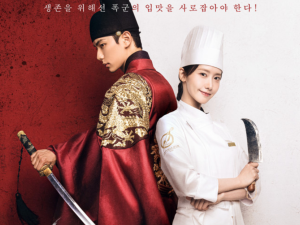
4. Yeon Ji-yeong is a South Korean chef expert in French cuisine who has just won a grand prize in Paris. As she is flying back home, during a total sun-eclipse, she is thrown back into the Joseon era – but without explanation. Now, when we have a fairy tale or a fantasy, contrary to our known history and reality, our disbelief must be suspended correspondingly. This does not take place with Yeon’s transference to the Joseon Dynasty. This is the first weak point in the scenario.
The first episode seems to me very long drawn before Yeon accepts the fact that she is in the past and in the reign of the king Ye Heon, the best gourmet and the worst tyrant in the history books. Lim Yama as the female chef is very good and deserved the awards she got as Actress of the Year in TV etc. (She was just as good in the King the Land 2023). But Lee Chae-nin as the king is not as good, nor Kang Han-ra as the beautiful, cruel, jealous, scheming queen Kang Mok-ju. This inferior acting is the second blemish.
5. When you tamper with known history you are bound to have lapses or contradictions in the script. The King tends toward tyranny and cruelty in the first few episodes and the chef keeps describing him as such, but this aspect does not emerge convincingly. In any case, thanks to Yeon’s influence he becomes quite benevolent. Then, we have the book with the recipes which Ji Yeong keeps in her bag. This gets lost but meanwhile the king writes a book of the excellent meals she prepared, and this becomes now the (lost) book!
The worse discrepancy is in the last episode where Ji Yeong returns back to the present – but I leave that to the end.
There are some inevitable cliches that we meet in almost all Korean series, and we find them here too. The protagonist, man or woman, has a traumatic experience in childhood. Here the king suffers because he does not know the exact circumstances of his mother’s death. (A similar situation in King the Land!) Another element is the hero covering with a blanket (or scarf or coat) the sleeping heroin to show that he cares and protects her. A third cliche is the initial dislike of the heroine for the hero (often both disliking one another). A fourth one is the withholding of information that would reveal the truth and remove all misunderstandings between them.
A little more care on the part of the script writer and the director would have made this romantic fantasy a very good series.
The ending is totally unacceptable, even though predictable from the moment Ji-yeong is struck dead by the Prince Je-san (who has organised a rebellion to obtain the throne) as she protects the king. She gets miraculously transferred to the 21st century, to her family house where her father is awaiting her. But, then, all her culinary companions and the king himself again miraculously appear in forms of the 21st century and the two lovers reunite in typical romantic comedy fashion. Here again this miracle is given no explanation of any kind.